Skip to content
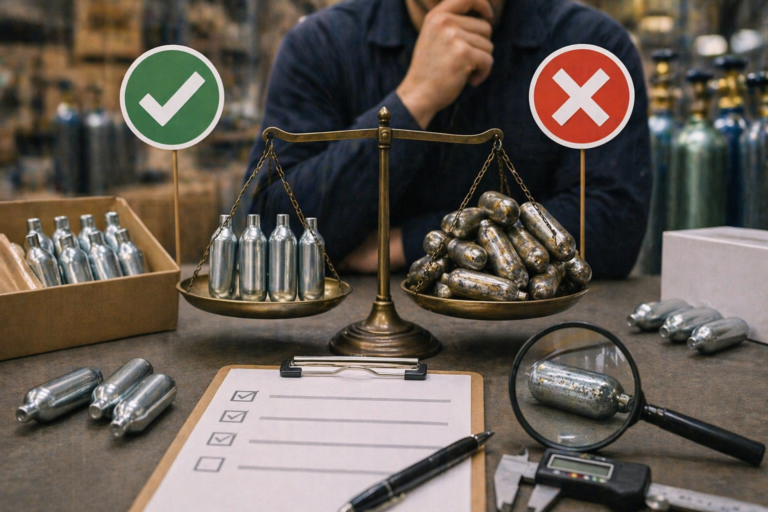
What Do Samples Actually Prove—and What Do They Hide?
This is a question I hear all the time.
A buyer receives samples, tests them, and everything looks perfect.
The gas works. The valve fits. The packaging looks clean.
So they move forward with a full container order.
But then, a few months later, problems start appearing.
“The new batch feels different.”
“We’re getting more complaints.”
“The quality isn’t the same as the sample.”

So what went wrong?
From the factory side, the answer is simple:
Samples can prove some things—but they definitely don’t prove everything.
TL;DR
Samples are useful, but they only verify:
- Basic product compatibility
- Initial gas performance
- Visual quality
They do NOT guarantee:
- Batch consistency
- Large-scale production stability
- Packaging durability in shipping
- Long-term supplier reliability
What Samples Are Actually Good For
Samples are still important. They help buyers answer a few key questions:
- Does the charger fit standard equipment?
- Is the gas pressure and performance acceptable?
- Is the valve functioning correctly?
- Does the product match the expected specifications?
These are necessary checks before moving forward.
From our experience, almost every serious buyer starts with sample testing. That part is correct.
What Samples Cannot Tell You
The problem is that samples are usually produced under ideal conditions.
In many cases:
- They are selected from the best production batches
- They are tested individually
- They are not exposed to real shipping conditions
This means samples don’t reflect:
| Risk Area | Why Samples Don’t Show It |
|---|---|
| Batch variation | Samples come from limited runs |
| Packaging damage | No real transport stress |
| Production speed issues | Not tested at scale |
| Long-term consistency | Only short-term evaluation |
That’s why relying only on samples can create a false sense of confidence.
The Batch Consistency Problem
The biggest gap between samples and real orders is consistency.
Producing 10 perfect samples is easy.
Producing 10,000 identical units consistently is much harder.
That difference comes from:
- Machine calibration stability
- Operator consistency
- Quality control processes
- Production speed
Buyers who understand this usually ask about batch control, not just sample quality.
Many experienced importers also review technical references such as the
ISO pressure vessel testing standards
to better understand how large-scale production should be controlled.
Packaging: The Hidden Risk
Another thing samples rarely reveal is packaging performance.
Samples are typically shipped in small boxes, carefully handled.
But real orders involve:
- Full container loading
- Long-distance sea transport
- Multiple handling stages
Weak packaging may not show any issues in samples, but can fail during bulk shipping.
That’s why experienced buyers always ask about:
- Carton strength
- Internal support structure
- Pallet stacking method
What Smart Buyers Do Instead
Instead of relying only on samples, experienced buyers usually take additional steps.
They might ask:
- Can I see production videos?
- How do you control batch consistency?
- Can you provide inspection reports?
- What is your defect rate history?
They also try to understand the supplier’s full process by reviewing materials like our
cream charger manufacturing and quality system overview
before committing to large orders.
This gives them a much clearer picture of what to expect.
When Samples Are Still Enough
There are cases where samples are sufficient—for example:
- Small trial orders
- Low-risk markets
- Testing new product categories
But for large-scale distribution, samples should only be one part of the evaluation process.
Final Thoughts
Samples are useful, but they are only the beginning.
If you want to build a stable cream charger business, you need to look beyond the sample and understand the system behind the product.
Because in this industry, consistency matters more than perfection.
And consistency is something you can’t fully see from a few sample pieces.