Skip to content
I’ve worked behind the scenes for years—supporting dozens of cream charger brands across Europe, Southeast Asia, and the US. I’ve seen launches succeed, fizzle, or crash hard. But what if I had to build one myself today, from scratch?
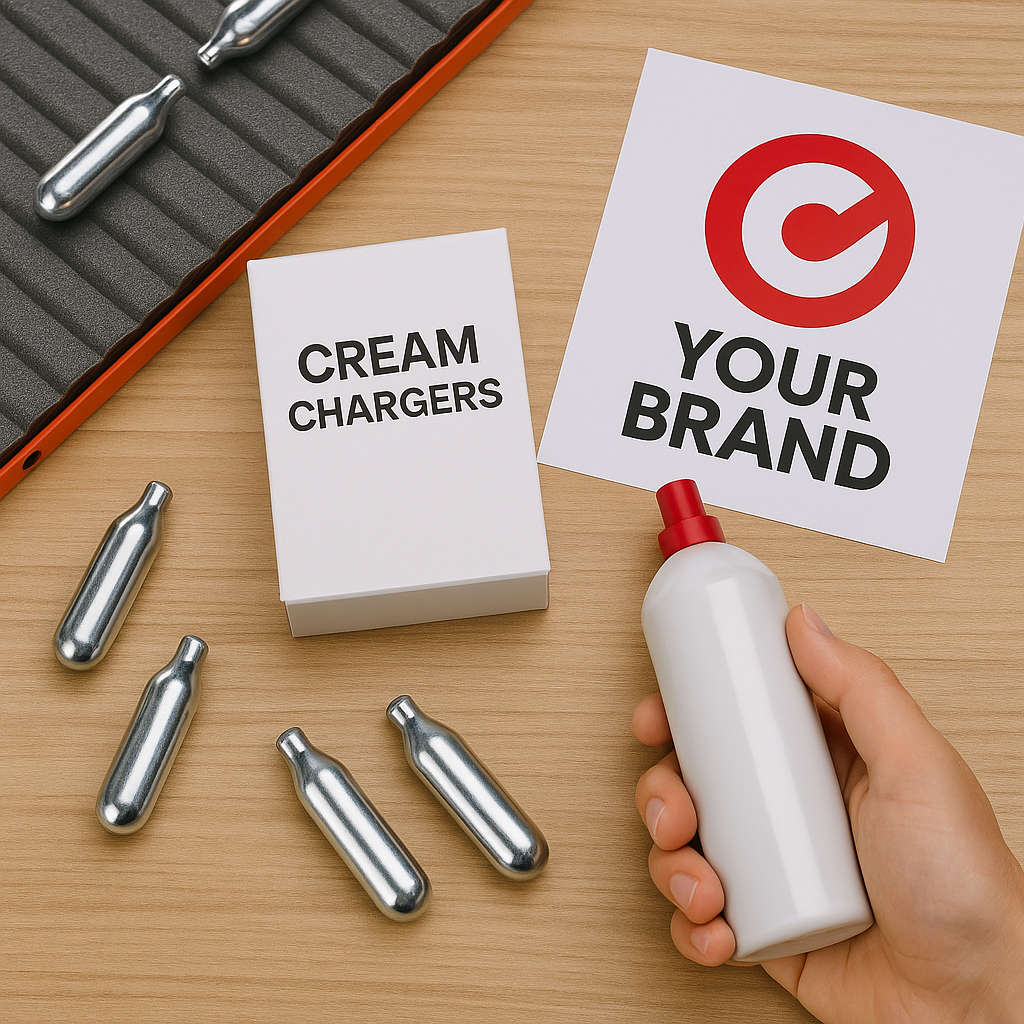
Looking back, I know exactly what I’d do differently. And if you’re thinking of starting your own cream charger line, I hope my experience saves you time, money, and stress.
1. I’d Start with One Format Only (and Master It)
The biggest mistake I see is buyers who want to launch 8g, 580g, 640g, and 3.3L tanks all at once. I get the temptation—more SKUs = more sales, right?
Wrong.
More SKUs = more logistics, more labeling, more stock management, and more chance for error.
If I had to do it all over, I’d start with one format—likely 640g steel tanks—and get everything perfect:
- Branding
- Certification
- Label layout
- Pallet loading
- Regulator accessory
- Pricing strategy
Once that flows smoothly, then scale.
2. I’d Choose a Real OEM Factory—Not a Trader with a Brochure
I used to think all suppliers were basically the same. Big mistake.
Now I know to look for:
- Their in-house printing capabilities
- Sticker vs. laser engraving options
- Access to TPED/FDA certificates in my name
- Flexible MOQ for mixed SKUs
- Willingness to make packaging mockups before production
If your supplier just says “we do OEM” but can’t show you past designs or dielines, they’re not OEM—they’re just selling someone else’s goods.
3. I’d Invest in Accessories First, Not Fancy Boxes
Your box design doesn’t matter if your tank leaks or your regulator breaks.
I used to obsess over gradients, logos, and box finishes. But most successful brands focus on:
- Regulator quality
- Nozzlecompatibility
- Clean, non-slip hose
- Protective packaging inserts
- Instruction cards in multiple languages
In fact, some of our most loyal buyers started with plain boxes—but offered plug-and-play regulator kits that made customers come back again and again.
4. I’d Launch Through WhatsApp and Distributors—Not Only Online Stores
Everyone says “set up a Shopify and run Facebook ads.” Sure, that can work. But in this niche, personalized B2B selling still wins.
If I were starting today, I’d:
- Use WhatsApp Business to connect with retailers
- Build a list of small regional distributors
- Offer samples with accessories included
- Send an FAQ pack and comparison chart
- Use Google Drive folders to host PDFs and videos
- Offer private labeling from Day 1 (with MOQ of 500 pcs)
That’s how we see real brands grow in Italy, Nigeria, Australia—even Germany.
5. I’d Build a Support System, Not Just a Product
Buyers don’t just want gas—they want:
- Safety advice
- Videos on how to use the regulator
- Warranty policies
- Local language labels
- Proof of CE / FDA compliance
- A reason to trust you over 20 other copycat brands
So if I were launching today, I’d build:
- A Google Drive folder with all compliance docs
- PDF guidebooks per market (EU, UK, AUS)
- Pre-written “how to sell” content for my retailers
- A proper tracking system for batch codes
The brands that win aren’t just flashy—they’re organized.
Conclusion
If I had to start a cream charger brand today, I’d skip the shortcuts and build real systems. I’d simplify. I’d go deeper before going wider. And I’d choose a factory that doesn’t just produce gas—but supports growth.
You don’t need to be the cheapest. You just need to be the most reliable and ready.