Skip to content
Don’t get me wrong—I like 3.3L tanks.
They’re big, impressive, and profitable if everything is set up right.

But if you’re a brand just getting started, or you’re still figuring out your supply chain?
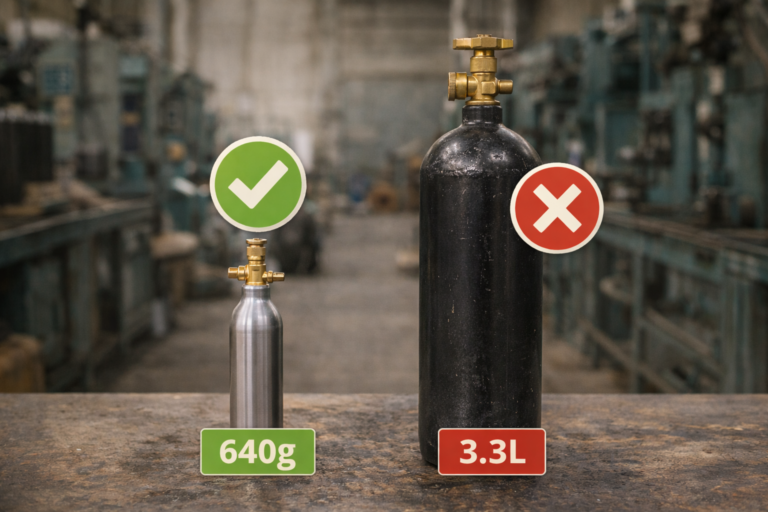
Then I’ll be honest: I still recommend 640g tanks over 3.3L, almost every time.
Let me explain why, based on what I’ve seen behind the scenes as a manufacturer.
TL;DR – Why 640g Wins for Most Brands
- ✅ Lower MOQ, faster lead time
- ✅ Easier packaging, fewer damage claims
- ✅ Fewer customs headaches
- ✅ Simpler for end-users to handle
- ✅ More flexible branding + bundling
Real Factory Perspective – What We See From the Production Floor
Here’s what happens when someone orders 640g:
- We can fill, label, seal, test, and pack faster
- Pallet loading is highly optimized (e.g., 504 pcs/pallet x 24 pallets/20GP)
- Box structure is standard across clients—less trial and error
- Labels are already TPED/CE-ready for EU compliance
- Most of our accessory kits (regulators, hoses) are built around this size
Now here’s what happens with 3.3L:
- Production speed is slower
- Bulk tank packaging requires extra stabilization
- Burst pressure is higher—meaning more scrap loss if there’s a valve issue
- Labeling must be custom-fitted due to bottle curvature
- Some countries treat them as reusable, triggering extra customs forms
In short? 640g is predictable. 3.3L is powerful—but complex.
Side-by-Side Comparison Table
| Spec | 640g Steel Tank | 3.3L Steel Tank |
|---|---|---|
| MOQ | 1,000 pcs | 200 pcs |
| Common Valve | M11 x 1 | G1/4 or UNF |
| Pressure Test | 180 bar | 200+ bar |
| Labeling | Flat sticker or wrap | Needs curved label / engraved info |
| Box Type | Standard printed or plain | Custom-fit inserts + handle clearance |
| User Handling | One-hand use, disposable | Two-hand, refillable or with regulator |
| Compatible Kits | Hose + regulator bundles | Requires upgraded regulator + safety lock |
| Common Use | Bars, catering, home brands | Lounge, refill stations, large kitchens |
What Buyers Get Wrong About 3.3L Tanks
Here’s what most new clients think:
“If I buy bigger, I look more premium.”
“Big tank = big margin.”
“I’ll just print my logo and start shipping.”
Here’s what actually happens:
- Shipping costs go up
- Label layout gets rejected by customs (π mark too small, language missing)
- Regulator doesn’t fit securely—causing leaks or refunds
- Customers don’t know how to store the tank safely
- Distributor needs training, not just marketing
💡 We’ve had buyers launch with 3.3L and switch back to 640g within two months—just to regain control.
Why 640g Is Still the Best Launch Size
If you’re just starting, 640g lets you:
- Test your market with smaller quantities
- Use standard packaging we already have templates for
- Get faster production (7–10 days vs. 15–20 for 3.3L)
- Bundle with accessories for a “starter kit”
- Avoid 80% of the customs and compliance questions that come with refillable tanks
It’s not about playing small—it’s about scaling smart.
Conclusion – Learn Big, Start Smart
3.3L tanks are great when you’re ready.
But 640g is what gets you ready.
You can build:
- A reliable supply chain
- A predictable shipping cost model
- A repeatable customer experience
- And yes—real brand equity
👉 Want to compare both formats side-by-side, with actual burst test videos and packaging samples? We’ll send you our factory guide →