Skip to content
I’ve helped launch more than 100 cream charger brands—some big, some niche, some that scaled to 5 containers a month… and some that never came back after their first pallet.
If I were to start my own brand today, from scratch, in 2026…
I wouldn’t aim to be the cheapest.
I wouldn’t try to do everything at once.
And I definitely wouldn’t copy what most people are doing on Alibaba.
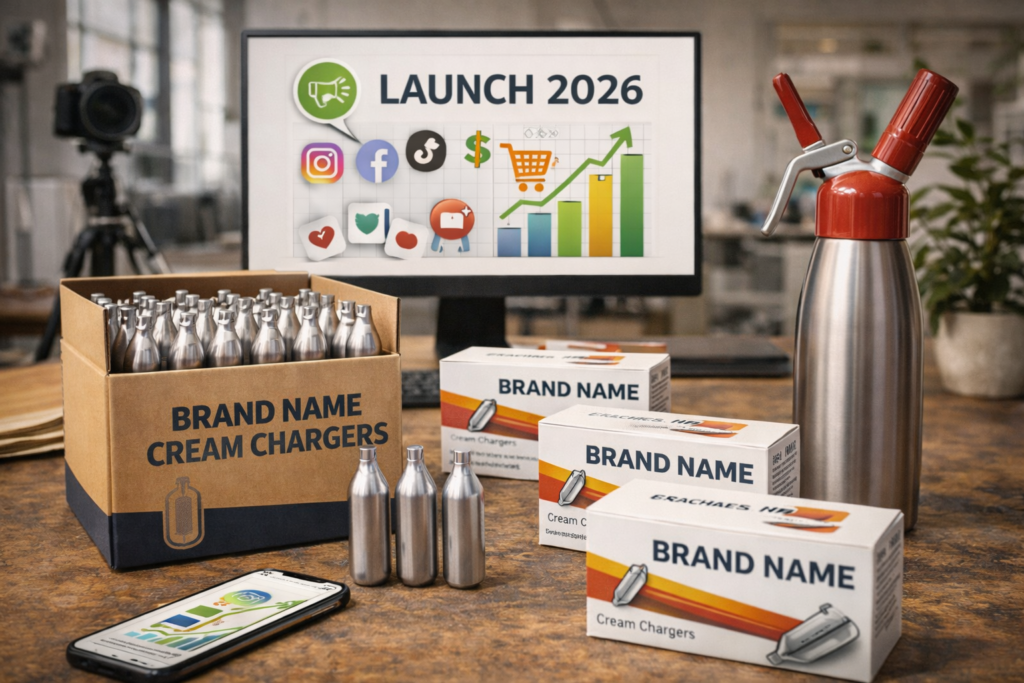
Here’s what I’d actually do—based on what I’ve seen inside the factory.
TL;DR – What I’d Focus On (and Avoid)
- ✅ Pick one SKU (640g) with the most stable packaging + gas volume
- ✅ Build compliance into the product, not after the fact
- ✅ Focus on unboxing and after-use experience
- ✅ Create a 3-month reorder loop with traceable packaging
- ✅ Partner with a factory that can support—not just supply
Step 1: I’d Start With One SKU and Make It Operationally Perfect
That means:
- 640g steel, food-grade N2O
- TPED π marking, UN1070 printed on label
- M11 x 1 valve, leak-tested with full COA
- Shrink sleeve or direct print (no stickers that fall off)
- Packed in trays, 504 pcs/pallet, 24 pallets per 20GP
I’d skip:
- Flavors
- Printed boxes
- Accessory bundling
- 3.3L tanks
- Multiple cap colors
💡 You don’t need 5 SKUs to impress buyers.
You need 1 SKU that delivers a perfect experience.
Step 2: I’d Build a Label That Thinks Like a Customs Officer
Here’s what I’d include—by default:
| Label Element | Why It Matters |
|---|---|
| UN1070 | Mandatory for DG classification |
| π 0035 | TPED compliance for EU |
| Production batch code | Needed for recall or complaint traceability |
| Net weight in g and kg | Customs label standard |
| Safety icon + warning | Avoid seizure for “unmarked gas” |
| QR code (optional) | Trace to certificate or user manual |
I’ve seen too many brands held at port for a $0.05 sticker issue.
I’d never let that happen to mine.
Step 3: I’d Plan My Customer Journey Before I Print a Single Box
Most buyers only think up to:
“How do I get the product from the factory?”
But I’d map all the way to:
- Who opens the box
- Where they use it
- What accessories they need
- What questions they’ll ask
- What will trigger a return
Then I’d build a box + insert + QR system that:
- Shows regulator setup
- Offers a refill reminder
- Links to a basic tutorial
- Reinforces the brand’s promise
Even if you sell B2B, your buyer remembers how your box felt—not just what it cost.
Step 4: I’d Treat My Factory Like a Creative Partner, Not Just a Supplier
I wouldn’t chase 5 quotes on Alibaba.
I’d pick one factory that can:
✅ Show me real pressure test videos
✅ Suggest how to avoid transit damage
✅ Help me optimize pallet loading
✅ Push back when I make a mistake
✅ Walk me through certification renewals
🧠 The best brands we’ve seen didn’t treat us like vendors.
They treated us like part of the team.
Conclusion – Build to Reorder, Not Just to Launch
If I were launching today, my main goal wouldn’t be visibility.
It would be repeatability.
Make it easy for the customer to order again.
Make it easy for customs to approve.
Make it easy for the warehouse to pick and pack.
And make it easy for the factory to say:
“This client’s going somewhere. Let’s prioritize their line.”
👉 Want help building your first SKU, label, and reorder loop? Let’s build it together →