Skip to content
I talk to a lot of distributors every week.
Some are new.
Some have been in the gas business for 10 years.
And some are already moving multiple containers a month.
But there’s one thing almost nobody talks about openly:
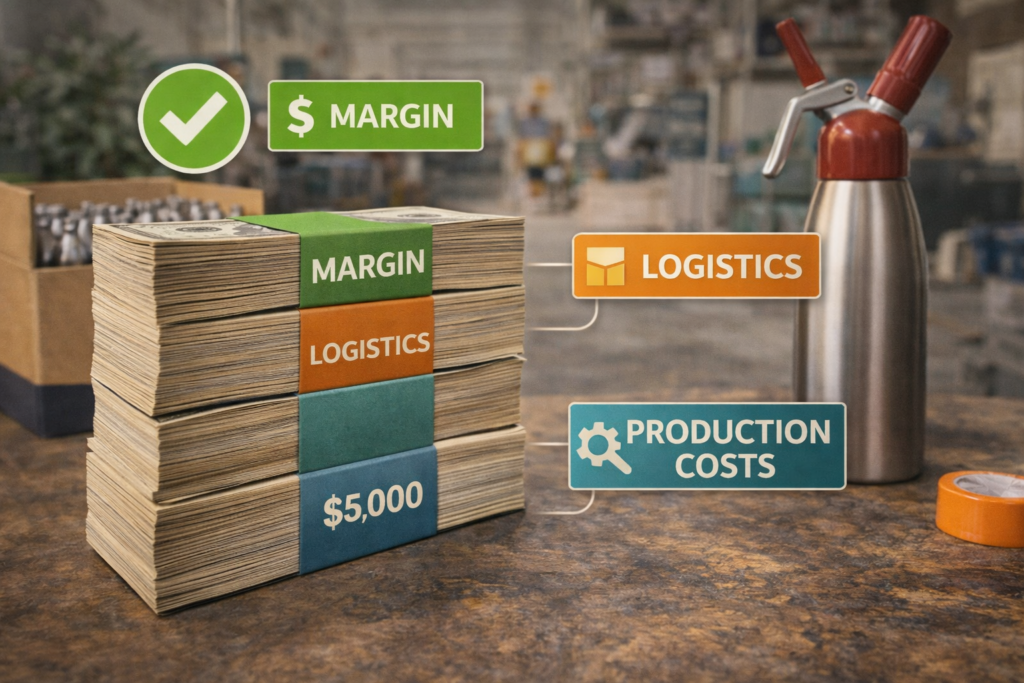
The real margin structure behind cream charger imports.
Not the marketing story.
Not the “cheap supplier” pitch.
But the real math that determines whether a brand survives.
After watching hundreds of shipments leave our factory, I can tell you this:
Most brands don’t fail because of bad products.
They fail because they misunderstand where the margin actually comes from.
Let me break it down from the factory side.
TL;DR
Most new importers think profit comes from buying cheaper.
In reality, sustainable cream charger brands make money from:
- Stable logistics costs
- Low return rates
- Consistent packaging
- Predictable reorders
- Distributor trust
Price matters—but it’s rarely the biggest factor.
What New Importers Usually Think
When someone first enters this business, the conversation usually starts like this:
“What’s your lowest price for 640g?”
“If I order one container, how much discount can I get?”
They assume the profit model looks like this:
| Stage | Example |
|---|---|
| Factory price | $X |
| Import price | $X + shipping |
| Retail price | $X × 2 |
So they focus almost entirely on reducing the factory price.
But from our experience, that’s usually the smallest lever in the whole system.
What the Real Margin Structure Looks Like
From the factory side, we usually see something closer to this:
| Cost Component | Typical Impact |
|---|---|
| Factory price | 30–40% |
| Shipping & DG logistics | 15–25% |
| Import duties & clearance | 5–10% |
| Warehousing | 5–10% |
| Distributor margin | 20–40% |
In other words:
Logistics and distribution often matter more than the product price itself.
That’s why two brands buying from the same factory can end up with completely different profit margins.
Where Experienced Buyers Actually Optimize
When we work with buyers who move 3–5 containers a month, they rarely negotiate price aggressively.
Instead, they optimize things like:
Pallet Efficiency
For example, a typical 640g configuration might be:
| Parameter | Typical Setup |
|---|---|
| Units per carton | 6 |
| Cartons per pallet | 84 |
| Units per pallet | 504 |
| Pallets per 20GP | 24 |
| Total units per container | 12,096 |
Small packaging changes can increase container capacity by 5–8%.
Over multiple shipments, that matters much more than saving a few cents per unit.
Damage Reduction
One of the biggest hidden costs is transport damage.
A few years ago, we worked with a client whose shipments were arriving with 2–3% dented tanks.
After we redesigned the packaging with tray inserts and stronger cartons, the damage rate dropped to below 0.2%.
That single change improved their effective margin more than any price negotiation.
Reorder Stability
Experienced distributors also focus heavily on predictable supply.
From our production records, the clients who scale usually:
- Order the same SKU repeatedly
- Avoid constant label redesign
- Lock packaging specifications early
- Maintain consistent reorder cycles
This allows us to optimize production runs and keep lead times stable.
In return, they get a much smoother supply chain.
A Quick Reality Check for New Buyers
If you’re just starting out in this industry, here’s something I always tell people:
The cream charger business is not a “buy cheap, sell expensive” game.
It’s closer to a logistics and reliability business.
The brands that survive usually:
- Keep their SKU lineup simple
- Build trust with distributors
- Avoid quality complaints
- Maintain stable shipping patterns
Once that system works, the margin takes care of itself.
Conclusion
When people ask me what the most profitable cream charger brands have in common, my answer is always the same:
They don’t obsess over the factory price.
They focus on predictability.
Predictable packaging.
Predictable logistics.
Predictable product quality.
Predictable reorder cycles.
That’s what turns a one-container experiment into a long-term business.
And from the factory floor, it’s very easy to see which buyers understand that—and which ones are still chasing the wrong numbers.