Skip to content
If you’ve ever imported cream chargers, you probably know this feeling.
Everything looks ready. Production is finished. The container is loaded. Documents are prepared.
Then suddenly—you get a message:
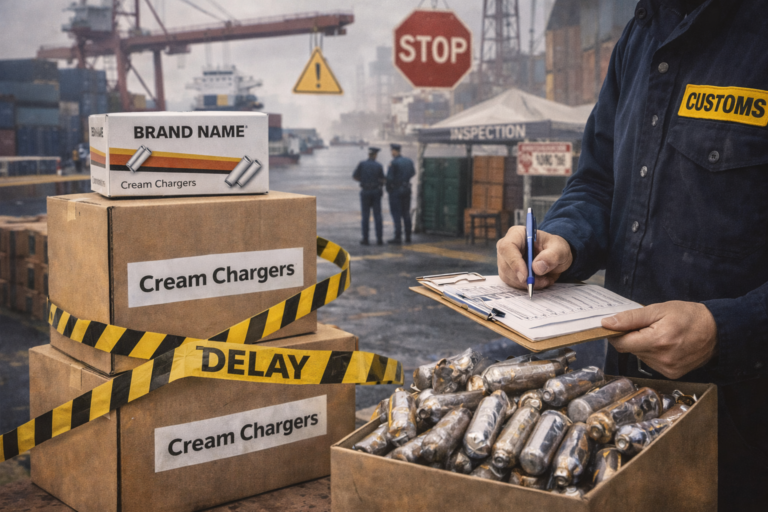
“Your shipment is being held at the port.”

I’ve seen this happen to both new buyers and experienced distributors. And almost every time, the reason is not random. It’s something that could have been avoided earlier.
From the factory side, port delays usually come down to a few very specific issues.
TL;DR
Cream charger shipments are usually delayed because of:
- Incorrect or incomplete dangerous goods documentation
- Missing or non-compliant labeling
- Mismatch between documents and actual cargo
- Forwarder unfamiliar with gas product handling
Most delays can be prevented before the shipment leaves the factory.
The Documentation Problem
Cream chargers are classified as dangerous goods, which means shipping requires more documentation than normal products.
Typical required documents include:
- Dangerous Goods Declaration
- Packing List
- Commercial Invoice
- MSDS / SDS
- UN classification information
If any of these documents are incomplete or inconsistent, customs or port authorities may stop the shipment for inspection.
Buyers who understand the classification rules explained in the
UN dangerous goods transport classification system
usually avoid the most common documentation mistakes.
Labeling Mistakes Are More Common Than You Think
Another major cause of delays is incorrect labeling.
For cream chargers, labels must clearly show:
- UN1070 classification
- Net gas weight
- Safety warnings
- Batch or traceability information
If labels are missing, unclear, or placed incorrectly, port inspectors may require additional verification.
In some cases, the shipment may even need to be relabeled before release, which can cause significant delays.
Document vs Cargo Mismatch
This is a problem that many first-time importers don’t expect.
Sometimes the issue is not the documents themselves, but the difference between documents and actual cargo.
For example:
- The declared quantity does not match the actual shipment
- The product description is inconsistent
- The packaging type is different from what is listed
Even small inconsistencies can trigger inspections.
That’s why experienced buyers usually double-check every detail before shipment.
The Forwarder Factor
Not all freight forwarders are experienced in handling dangerous goods.
This is a critical point that many buyers overlook.
An experienced forwarder understands:
- DG booking procedures
- Required documentation formats
- Carrier restrictions
- Port inspection expectations
An inexperienced forwarder may miss important steps, leading to delays that could have been avoided.
How We Help Prevent Delays
From our factory side, we’ve learned that prevention is much easier than solving problems at the port.
Before shipment, we usually confirm:
| Checkpoint | Purpose |
|---|---|
| Label inspection | Ensure compliance with export standards |
| Document review | Match packing list, invoice, and DG declaration |
| Packaging verification | Confirm DG-safe packing structure |
| Batch traceability | Ensure tracking in case of inspection |
Many of our clients review our
cream charger export preparation and documentation process
before their first shipment so they understand how we align production, labeling, and documentation.
This reduces the risk of unexpected delays significantly.
What Experienced Buyers Always Do
Buyers who rarely face port delays usually follow a simple process:
- Confirm labeling before production
- Review documents before shipment
- Work with experienced DG forwarders
- Avoid last-minute changes
They treat shipping as part of the product—not as a separate step.
Final Thoughts
Port delays are frustrating, but they are rarely unpredictable.
In most cases, they are the result of small details that were missed earlier.
If you prepare documentation carefully, verify labeling, and work with experienced partners, the risk becomes much lower.
From the factory side, we always say:
A smooth shipment is not luck. It is preparation.