Skip to content
I’ve had this exact conversation with buyers more times than I can count.
A new client comes to me and says: “We found another supplier with a lower price. Can you match it?”

Sometimes I can. Sometimes I can’t. But what I always tell them is this:
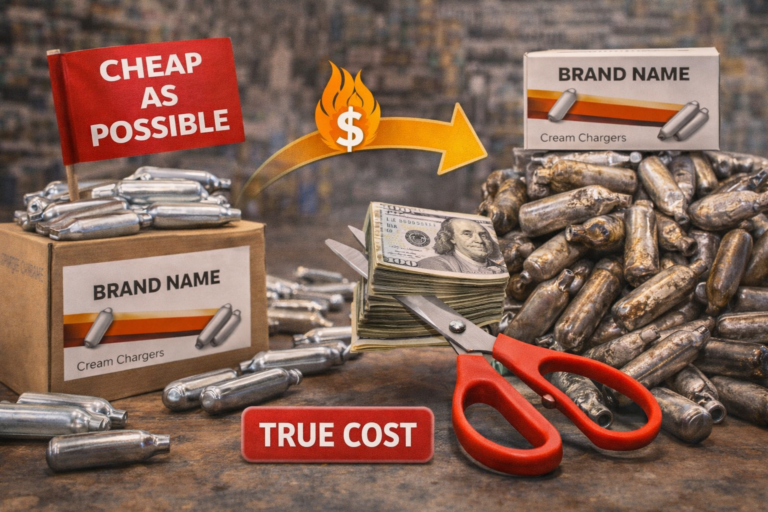
In the cream charger business, the lowest price on paper is very rarely the lowest cost in reality.
And after a few shipments, most buyers start to understand why.
TL;DR
The cheapest cream charger supplier often becomes expensive because of:
- Higher defect and return rates
- Unstable product consistency
- Shipping and compliance risks
- Hidden operational costs
Real cost is not just the unit price. It is the total cost of problems.
Where the “Cheap Price” Usually Comes From
From a factory perspective, extremely low prices usually come from cutting costs in specific areas.
These are the most common ones:
| Cost Area | What Gets Reduced |
|---|---|
| Steel material | Thinner cylinder walls |
| Gas filling | Less precise weight control |
| Valve components | Lower sealing reliability |
| Quality inspection | Fewer or faster checks |
| Packaging | Weaker cartons |
On paper, the product still looks the same. But in real distribution, the difference becomes obvious very quickly.
The Return Rate Problem
One of the biggest hidden costs is product returns.
If even a small percentage of cream chargers leak or fail to work properly, distributors will immediately feel the pressure from retailers.
From what I’ve seen in real shipments:
- A stable product usually stays below 0.1%–0.2% issue rate
- Unstable products can easily exceed 0.5% or more
That difference may look small, but for large-volume distributors, it becomes a serious operational problem.
Handling complaints, replacements, and damaged brand reputation often costs much more than the initial savings.
Compliance Risks Are Often Ignored
Another area where cheap suppliers cut corners is compliance.
Cream chargers are classified as dangerous goods, which means production, labeling, and transportation must follow strict standards.
Buyers who understand the requirements outlined in the
Compressed Gas Association safety standards
usually pay close attention to documentation and testing procedures before placing orders.
Suppliers who offer very low prices sometimes lack proper documentation or consistency in compliance, which can lead to:
- Shipping delays
- Customs issues
- Rejected shipments
These problems can completely erase any price advantage.
The Real Cost of Unstable Supply
One thing many new buyers underestimate is the cost of instability.
When supply is inconsistent, it creates several problems:
- Inventory gaps
- Delayed deliveries to retailers
- Lost shelf space
- Reduced customer trust
These issues are difficult to measure in advance, but they directly affect long-term business growth.
Many distributors review our
cream charger bulk supply system and production control
before committing to long-term cooperation, because they want to ensure that supply remains stable as their business grows.
Cheap Suppliers Often Cannot Scale
Another pattern I’ve seen is that low-cost suppliers often struggle when order volumes increase.
At small volumes, they can manage production. But as orders grow, problems start to appear:
- Inconsistent quality between batches
- Delayed production schedules
- Limited capacity expansion
This becomes a major issue for distributors who want to scale their business from a few pallets to multiple containers per month.
What Experienced Buyers Do Instead
Experienced buyers usually take a different approach.
Instead of focusing only on price, they evaluate:
- Production stability
- Quality control systems
- Compliance documentation
- Supplier communication
They understand that a slightly higher unit price can actually reduce total costs over time.
Final Thoughts
In this industry, price is always important. But it should never be the only factor.
The real question is not:
“Who is the cheapest supplier today?”
The better question is:
“Which supplier will create the lowest risk over the next three years?”
Because in the cream charger business, the cheapest option often becomes the most expensive lesson.